Dog Bed Shapes Explained: Flat, Donut, Bolster, Cave

Walk into any pet aisle and you will see round beds, flat beds, beds with walls and beds with a roof. They are not just different looks. Each shape gives your dog a different surface to lie on. This guide explains the four main ones in plain words, so you can pick the one that fits how your dog really sleeps.
Looking for size and measuring? We cover that in How to Choose a Dog Bed: Size, Shape and Fill. Here we stay on shape.
Start with how your dog sleeps
Dogs fall into a few familiar sleeping poses. Knowing yours makes the shape choice much easier.
- Curled up. The vet-reviewed PetMD article describes it this way: "Curled up in a tight ball, dogs in the donut pose have their limbs tucked close". VCA Animal Hospitals puts it more simply: "Your dog is curled up into a tiny ball."
- On the side. VCA: "Your dog is in deep sleep on their side with their feet out from under them."
- Stretched out. PetMD calls one version the superman pose: "Stomach down with back legs straight out behind them and front legs stretched forward".
- On the back. VCA describes dogs who "lie on their back with all their limbs sticking straight up".
Watch your dog nap for a few days. Most dogs have a favourite pose, and some switch from one to another in the same hour.
Flat beds, mats and cushions
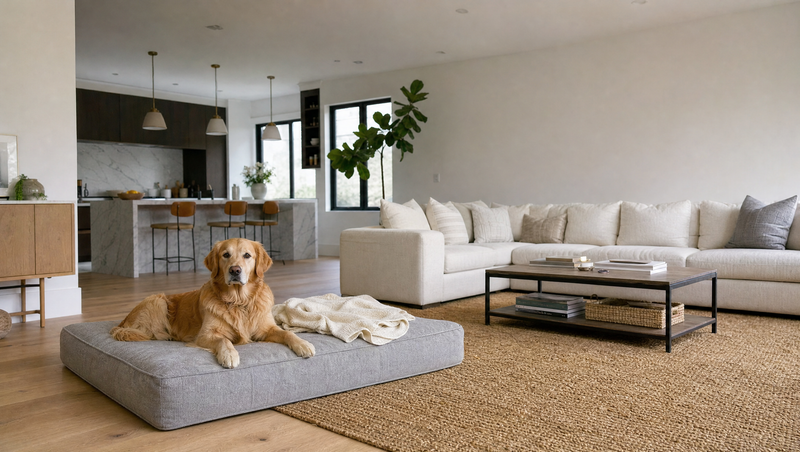
A flat bed has no walls. It is a cushion or a mat, and the whole top is open. Your dog can step on from any side and lie in any direction.
- What it looks like: a rectangle or an oval, low to the ground, with an even surface.
- Who it suits: dogs that stretch out, sprawl or sleep on their side, since nothing limits the space.
- Where it works: a hallway, a crate, the back of a car, the corner of the kitchen.
The AKC lists the pillow dog bed among its bed types and talks about giving a dog "more than enough space to stretch out and snooze". Browse our flat beds and mats.
Donut and nest beds
A donut bed is round, with a raised ring of padding all the way around and a dip in the middle. The name comes from its look. It also happens to share its name with the pose we met above, where a dog is curled in a tight ball.
- What it looks like: a round or oval bowl shape. The sides are lower than a wall, higher than a mat.
- Who it suits: dogs that sleep curled up, nose near the tail.
- Where it works: a living room corner or beside your own bed.
The dip means the sleeping area is smaller than the outside size. Check the listed inside dimensions. See our nests and caves.
Bolster beds
A bolster is a long, rolled cushion. A bolster bed has one on one, two, three or all four sides, with a flat floor in the middle. In French we say lit à traversin.
- What it looks like: a flat bed with raised, cushioned edges.
- Who it suits: dogs that like something to lean on or to rest a head against. They can lie on the floor of the bed or use the edge.
- Where it works: next to a wall or a couch, where the open side faces the room.
Our dog beds collection includes several with raised edges. If you want a back and two arms, like a tiny couch, look at our sofas and couches too.
Cave and hooded beds
A cave bed has a cover over part of the bed. It may be a hood, a flap or a built-in roof. Your dog slides in through an opening at the front.
- What it looks like: a bed with a tunnel or hood, a bit like a tent.
- Who it suits: dogs that like to burrow. The AKC says burrowing beds are "great for small dogs who love to burrow under blankets and feel cozy". It adds that dogs "feel snug and secure in covered dog beds, like they're in a small cave".
- Where it works: a quiet room where the bed can stay in one place.
A hood takes up space. Check the width of the opening and the room left inside. A dog that likes to stretch may find a hooded bed too tight. Have a look at our caves and hooded beds.
Side by side
| Shape | Suits this sleeping style | Check before you buy |
|---|---|---|
| Flat bed, mat, cushion | Stretched out, on the side, on the back | Overall length and thickness |
| Donut or nest | Curled up | Inside width, not only outside size |
| Bolster | Leaning or resting the head on an edge | Which sides are raised, and the length of the flat floor |
| Cave or hooded | Burrowing, curled up | Size of the opening and the room inside |
What if your dog does two things?
Many dogs do. A dog may curl up at night and sprawl in the afternoon sun. In that case, start with the pose you see most. If you cannot tell, a bolster or a large flat bed gives the most room to change position.
You can also keep two beds in two spots. One in the living room, one by your bed. Nothing says a dog must use only one.
Big dogs and big beds
Every shape above comes in larger sizes. If your dog measures long, start with our large dog beds. Remember that raised sides and hoods reduce the open space inside, so a big dog usually needs more room than the outside size suggests.
A short checklist
- Note the pose you see most often.
- Match it to a shape using the table above.
- Read the inside dimensions, not only the outside ones.
- Think about where the bed will sit.
- Choose the larger size if you are unsure.
Quick answers
What are the main types of dog beds?
Flat beds or cushions, donut or nest beds, bolster beds with raised edges, and cave or hooded beds. You will also see sofa styles with a back and sides.
Which shape is best for a dog that curls up?
A donut or nest bed matches the curled pose, since it has a raised ring around the dip. A small cave bed is another option if your dog likes to burrow.
Which shape is best for a dog that stretches out?
A flat bed or a large bolster bed leaves the most open space. Pick a size that is longer than your dog is when stretched.
Sources
- PetMD, 6 Dog Sleeping Positions and What They Mean: https://www.petmd.com/dog/general-health/dog-sleeping-positions-and-what-they-mean
- VCA Animal Hospitals, Dog sleeping positions decoded: https://vcahospitals.com/resources/behavior-dog/dog-sleeping-positions-decoded
- American Kennel Club, Choosing the Right Dog Bed for Your Dog: https://www.akc.org/expert-advice/lifestyle/best-dog-beds-choose-comfiest-bed-pup/
This article is general information, not veterinary advice.