How many hours do dogs sleep? (and why so much)

You come home, and your dog is asleep. You get up for a snack, and your dog is asleep. It is natural to wonder if this is too much. Short answer: for most dogs, a lot of sleep is completely normal. Here is what the numbers look like, why dogs sleep this way, and what is worth noticing.
How many hours a day do dogs sleep?
Adult dogs spend as much as half of their day asleep, which is roughly 12 hours, according to the American Kennel Club. Another veterinary hospital network gives a wider range for pets in general, 8 to 13.5 hours a day. Both are real answers. Dogs differ, and so do the ways people count. Naps, light dozing and deep sleep are not always separated.
A helpful way to picture a dog's day: about half of it asleep, about 30% awake but relaxed, and about 20% active. That is the split the American Kennel Club describes for adult dogs.
Sleep by life stage
| Life stage | Typical sleep per day |
|---|---|
| Puppies | 18 to 20 hours |
| Adult dogs | About 12 hours (up to half the day) |
| Senior dogs | 12 to 15 hours (some larger breeds up to 18) |
Treat these as ranges, not targets. Your dog's own normal matters more than any chart.
Why do dogs sleep so much?
Growing takes rest
Puppies sleep the most for a reason. Sleep supports healthy growth, including the development of the brain, nervous system, immune system and muscles. A puppy who crashes mid-play is not being lazy. That is the plan working.
A different kind of sleep
Dogs spend only about 10% of their sleep in REM, the stage linked with dreaming. People spend roughly 25%. Dogs also take a while to reach it, about 10 minutes. With less REM in each stretch of sleep, dogs may simply need more stretches. That is one common explanation for all the naps.
Size and age
Larger breeds tend to spend more time resting than smaller ones. Older dogs also tend to sleep more, partly because they tire more easily.
Not much else on the schedule
A dog's day is built around its people. Walks, meals, play and cuddles are the highlights. In between, resting is the easiest thing to do. A quiet house with an empty afternoon often means a long nap.
What does a restful sleep spot look like?
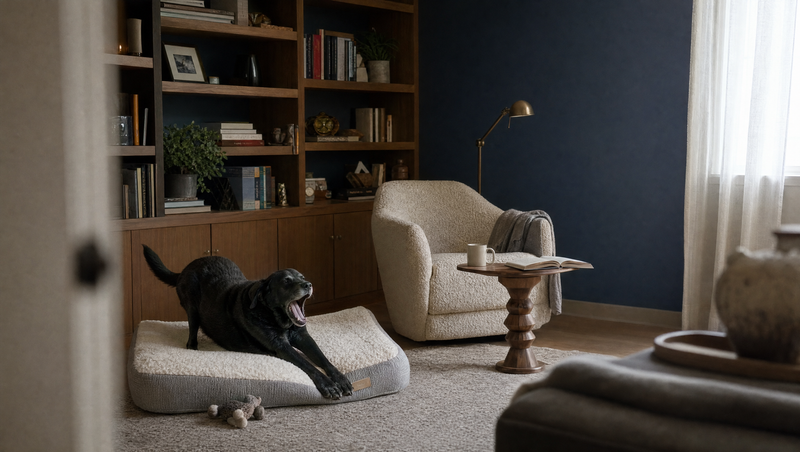
Dogs sleep in short and long stretches all day, so the place they choose matters. Think about three things:
- Size: Enough room to stretch out or curl up, depending on how your dog likes to sleep. If your dog is big, look at large dog beds.
- Placement: A spot away from drafts and heavy foot traffic, but close enough to the family to feel included.
- Washability: A removable cover makes it easy to keep the bed fresh.
If you are still choosing, our dog beds collection is a good place to start. Watch how your dog sleeps first: curled in a ball, flat on one side, or head propped on an edge. The shape that matches those habits is usually the right one.
What you can notice at home
You know your dog best. Changes tell you more than totals. A veterinary hospital network suggests asking yourself a few simple questions:
- Are these my dog's usual sleep times?
- Does my dog still get up for the usual things, like meals or the leash?
- Is my dog missing usual activities because of sleep?
- Does my dog seem alert and rested when awake?
For older dogs, the American Kennel Club lists a few things worth reporting to a veterinarian: not waking to sound, seeming unable to get comfortable, sleeping in new places, a change in appetite, less movement, or ignoring commands. It also quotes a veterinarian who notes that a dog sleeping more than 20 hours a day, or showing a clear shift in sleep habits, may be signalling something underlying.
We cannot tell you what a change means. Only a veterinarian can. If your dog's sleep shifts at the same time as other changes, such as vomiting or coughing, book a visit and share what you have seen. A few dated notes on your phone can help.
A note on research
Researchers have studied sleep in dogs using brain recordings. One study followed 28 senior dogs, with an average age of about 13 years, during 2-hour afternoon recordings. It found that dogs with higher cognitive scores on a dementia scale spent less time in both deep sleep and REM sleep. The study was small, and it measured only the afternoon, so it is a window into the topic, not the full picture.
Quick answers
How much sleep do dogs need?
It depends on age. Puppies often sleep 18 to 20 hours a day, and adults up to about half the day, roughly 12 hours. Seniors are commonly in the 12 to 15 range.
Is it normal for my dog to sleep all day?
Many dogs rest for around half the day. What matters most is whether this fits your dog's normal pattern and whether your dog is alert and interested when awake.
When should I call the veterinarian about sleep?
If you see a clear change from your dog's usual habits, or sleep changes arrive with other changes in appetite, movement or behaviour, talk to your veterinarian.
Sources
- American Kennel Club, "Why Do Dogs Sleep So Much?": https://www.akc.org/expert-advice/health/why-do-dogs-sleep-so-much/
- American Kennel Club, "How Much Do Puppies Sleep?": https://www.akc.org/expert-advice/health/how-much-do-puppies-sleep/
- American Kennel Club, "Can Senior Dogs Sleep Too Much?": https://www.akc.org/expert-advice/health/senior-dog-sleep-too-much/
- VCA Animal Hospitals, "Is your pet sleeping too much?": https://vcahospitals.com/resources/behavior-cat/concerns/is-your-pet-sleeping-too-much
- Frontiers in Veterinary Science (via PubMed Central), "Sleep and cognition in aging dogs. A polysomnographic study": https://pmc.ncbi.nlm.nih.gov/articles/PMC10175583/
This article is general information and not veterinary advice. If you are worried about your dog's sleep, talk to your veterinarian.