How Cold Is Too Cold for Dogs? Keeping Sleeping Spots Warm in Winter
The first hard frost is here, and your dog is curled in a tight ball. Are they cold? How cold is too cold? Sources give some numbers, but they all say the same thing first: it depends on the dog. Here is what they say, and how to set up a warm, safe sleeping spot for the winter.
The temperature guides
PetMD gives a three-step guide for time spent outdoors. Temperatures are in Fahrenheit in the sources, and we added Celsius in brackets:
- Below 45 °F (about 7 °C). "Cold should not become a problem for most dogs until the temperature falls below 45 F, at which point some cold-averse dogs might begin to feel uncomfortable."
- Below 32 °F (0 °C). Small breed dogs, dogs with thin coats, or very young, old or sick dogs "could be in danger if they spend too much time outdoors."
- Below 20 °F (about -7 °C). "All pet parents need to be aware that their dogs could develop cold-associated health problems like hypothermia or frostbite when outside for extended periods of time."
VCA Animal Hospitals gives a similar picture: when temperatures drop below 32 °F, it is time to take precautions, and at 20 °F or lower even short walks can be risky. It also says: "Generally, it is not safe to leave dogs outside during the winter."
It depends on the dog
The AKC says: "Small dogs, senior dogs, puppies, and short-coated dogs are at a higher risk of rapid loss of body heat." PetMD adds that puppies, senior dogs and dogs with underlying health problems cannot regulate their body temperature as well as healthy dogs in their prime. A husky and a chihuahua are not on the same chart.
Signs your dog is cold
PetMD lists signs such as shivering or trembling, holding their feet in the air, whining, a hunched posture with the tail tucked, being less active, and refusing to walk. PetMD's other page says that if you notice your dog shivering, anxious, whining, slowing down, or searching out warm locations, "it's time to head inside and warm up." The AKC says shivering and curling up for warmth are some of the first signs of mild hypothermia.
And a note on sleep: VCA says a dog curled into a tight ball may be "feeling the cold and is keeping warm." A curled-up dog is not always cold, since dogs curl up for other reasons too (see dog sleeping positions), but if the room is chilly it is worth checking.
Do dogs get cold at night indoors?
They can be. PetMD says: "Keep your home heated on cold winter days. If you are chilly, your pup probably is, too." That is a handy rule for a dog sleeping inside: if you would want a blanket, so might your dog.
Setting up a warm sleeping spot
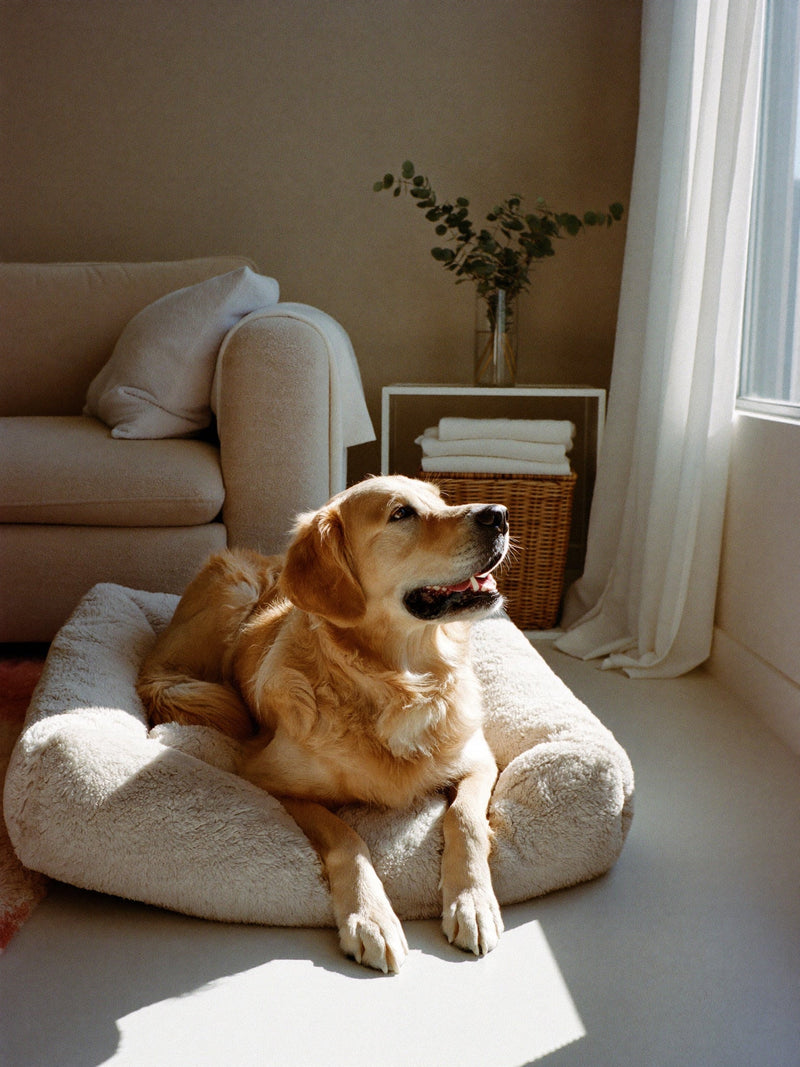
VCA gives a simple recipe: "A cozy bed with a blanket, off the floor and away from drafts, keeps your dog comfortable." Some practical ideas, mixing sources and general tips:
- Off the floor. From VCA. Floors, especially near doors and in basements, are the coldest part of a room. A bed already lifts a dog a little off the floor.
- Away from drafts. From VCA. Check the spot near exterior doors and windows.
- A blanket. From VCA. A washable blanket over or inside a bed is easy to add and wash.
- A shape that suits a curler. General tip: a dog who likes to curl up may like a nest or cave bed, where the sides give something to curl against. A sprawler may prefer a flat bed with a blanket on top.
- Easy to wash. Wet boots and snow come inside. Check the care label, and see how to wash a dog bed.
What about heated beds?
Here is what the AKC says about heated beds in general. It says heated dog beds are made to heat to a safe temperature for a dog's needs and work on low voltage, but supervised use is essential: "It's important to supervise your dog any time they're using a heated dog bed." The AKC says your dog could be at risk of overheating or getting burned if they have mobility issues and cannot get up easily, and that heated beds can be a concern inside a crate where a dog has little room. It also advises a chew-resistant cord kept out of reach, an automatic power shutoff and a non-skid bottom. Ask your vet if your dog is a senior or has trouble moving.
When to call the vet
PetMD says to call your veterinarian if you notice signs of frostbite or hypothermia, including sluggishness, confusion, severe shivering (which may stop as hypothermia progresses), and parts of the body that look pale and feel cool to the touch. The AKC says: "If you suspect your dog may be suffering from hypothermia, bring your dog somewhere warm if possible and contact your vet immediately."
Older dogs, too
If your dog is a senior, winter is also a good moment to check how they get on and off their bed. See senior dog restless at night and how to choose a dog bed, and browse all our dog beds.
Quick answers
At what temperature is it too cold for a dog?
PetMD says below about 7 °C (45 °F) some cold-averse dogs feel uncomfortable, below 0 °C (32 °F) small, thin-coated, young, old or sick dogs may be in danger outdoors, and below about -7 °C (20 °F) all dogs can develop cold-related problems if out for long.
How can I tell if my dog is cold at night?
Look for shivering, whining, a hunched posture, a tucked tail or a dog who seeks warm spots. If you are chilly, PetMD says your dog probably is too.
Where should my dog sleep in winter?
VCA suggests a cozy bed with a blanket, off the floor and away from drafts.
Sources
- PetMD, How Cold Is Too Cold for Your Dog?: https://www.petmd.com/dog/care/how-cold-too-cold-dog
- American Kennel Club, Hypothermia in Dogs: How Cold Is Too Cold?: https://www.akc.org/expert-advice/health/hypothermia-in-dogs-how-cold-is-too-cold/
- VCA Animal Hospitals, Dog Winter Safety Tips: https://vcahospitals.com/shop/articles/winter-safety-tips
- PetMD, How To Keep a Dog Warm in the Winter: https://www.petmd.com/dog/general-health/how-to-keep-dogs-warm-in-winter
- American Kennel Club, Are Heated Beds Safe for Your Dog?: https://www.akc.org/expert-advice/home-living/heated-beds-safe-dog/
- VCA Animal Hospitals, Dog sleeping positions decoded: https://vcahospitals.com/resources/behavior-dog/dog-sleeping-positions-decoded
This article is general information and not veterinary or behavior advice. If your pet's habits change suddenly, talk to your veterinarian.